POST HUMAN JURISPRUDENCE
Paper 1.1 — The Amendment Patch (Final Edition)
Paper 1.1 expands the foundational model introduced in Paper 1.0 by providing a global diagnostic of the major legal systems in operation today. It identifies four universal failure modes, presents three negative case studies, introduces the Amendment Patch model, and demonstrates the first deterministic rewrite of a traditionally interpretive legal standard.
This paper also introduces the Bias Zero Audit v0.9, outlines safeguards against emergent hierarchy, and describes governance of the amendment layer. It bridges Paper 1.0 to the more technical Paper 2.0.
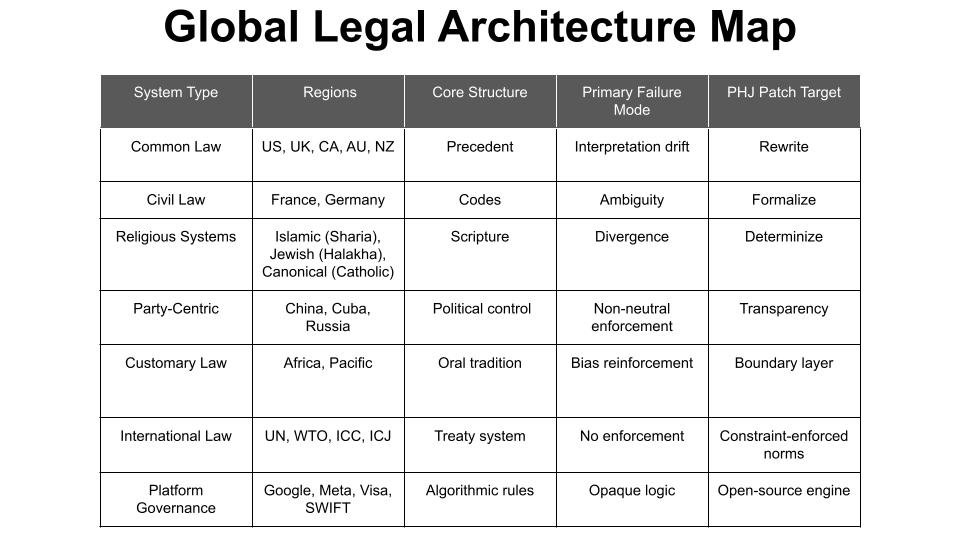
SECTION A1 — Global Legal Architecture Map
1. Global Legal Architecture Map
This section provides a high-level overview of the major legal systems operating worldwide. Each system displays one or more structural weaknesses tied to interpretation, context, or discretionary enforcement.
Common Law
Regions: United States, United Kingdom, Canada, Australia
Structure: Precedent-based
Primary Failure Mode: Interpretation drift
PHJ Patch Target: Constraint rewrite
Civil Law
Regions: France, Germany, Italy, Spain, Japan, South Korea, Latin America
Structure: Codified statutes
Primary Failure Mode: Textual ambiguity
PHJ Patch Target: Constraint formalization
Religious Legal Systems
Regions: Islamic jurisdictions, Jewish religious courts, Canon law states
Structure: Scriptural authority
Primary Failure Mode: Divergent interpretations
PHJ Patch Target: Deterministic definitions
Party-Centric Systems
Regions: China, Cuba, Russia, Central Asia
Structure: Party-controlled legal authority
Primary Failure Mode: Non-neutral enforcement
PHJ Patch Target: Transparent execution engine
Customary Law
Regions: Africa, Pacific Islands, Indigenous communities in Canada, Australia, and New Zealand
Structure: Oral and community-based rules
Primary Failure Mode: Social bias reinforcement
PHJ Patch Target: Fixed-rule boundary layer
Hybrid Systems
Regions: India, UAE, Israel, Malaysia, Indonesia, Japan
Structure: Overlapping civil, religious, and customary sources
Primary Failure Mode: Interoperability failure
PHJ Patch Target: Unification layer
International Law
Regions: UN system, ICC, ICJ, WTO
Structure: Voluntary compliance norms
Primary Failure Mode: Lack of enforcement
PHJ Patch Target: Constraint-enforced norms
Platform Governance
Regions: Global platforms (Google, Meta, Apple, Visa, SWIFT, OpenAI)
Structure: Algorithmic and code-based rules
Primary Failure Mode: Opaque decision logic
PHJ Patch Target: Open-source rule engine
SECTION A2 — Universal Failure Modes + Negative Case Studies
2. Universal Failure Modes Across All Legal Systems
Every system we examined — courts, religious law, customary systems, political systems, and digital platforms — displays recurring structural failures caused by interpretive dependency.
2.1 Interpretation Drift
Open-textured rules require human interpretation.
Interpretation changes over time, producing inconsistent outcomes.
PHJ Fix: deterministic constraints.
2.2 Context Variance
A rule’s meaning shifts depending on circumstance, location, or enforcement culture.
PHJ Fix: explicit rule boundaries and disallowed edge cases.
2.3 Discretionary Enforcement
Bias enters when humans choose how, when, or against whom a rule is applied.
PHJ Fix: execution engines that remove discretionary application.
2.4 Non-Interoperability
Legal layers conflict — civil, religious, customary, platform systems collide.
PHJ Fix: unification layer + constraint compatibility testing.
3. Negative Case Studies
These cases show how interpretation, bias, and hierarchy break systems across cultures and ideologies.
3.1 Indian Caste System (Social Hierarchy That Became Law)
Caste shows how a social hierarchy becomes a legal architecture even without being formally written.
It persists because:
community norms override statutes
enforcement officers belong to caste structures
courts inherit centuries of precedent
customary norms conflict with civil law
PHJ Insight: hierarchy can emerge without legislation; PHJ must detect and prevent emergent caste-like structures.
3.2 Sharia Interpretation Variance (Doctrinal Fragmentation)
Sharia varies by school, scholar, sect, and region.
This creates:
contradictory rulings
inconsistent definitions
outcome variance
jurisdictional fragmentation
PHJ Insight: principle survives; interpretation must be removed to prevent drift.
3.3 Carpenter v. United States (Fourth Amendment Stress Test)
Carpenter exposed three core failures:
Technology outpaced doctrine
Judges split philosophical models
Privacy became interpretive, not logical
PHJ Insight: advanced technology collapses interpretive law; deterministic constraints must replace doctrinal philosophy.
SECTION A3 — The Amendment Patch + Bias Zero Audit
4. The Amendment Patch Model
The Amendment Patch introduces a deterministic constraint layer that removes interpretation from existing rules.
It does not replace constitutions or legal systems — it patches them so they stop drifting, contradicting, or depending on human discretion.
The Patch converts an interpretive rule into three layers:
4.1 Definition Layer
Every vague term receives a deterministic, machine-testable definition.
4.2 Constraint Layer
The rule becomes a set of conditions that must pass or fail with no discretionary interpretation.
4.3 Execution Layer
The logic that applies the rule is transparent and reproducible.
This transforms rules from “what a judge thinks it means” into “what the rule must mean in all cases.”
4.4 Example: Deterministic Rewrite of Intent
Traditional intent varies wildly across courts, cultures, and contexts.
PHJ replaces interpretive intent with a deterministic test:
Intent_Determination:
  IF (Action_Preparation == True)
  AND (Outcome_Foreseeable == True)
  AND (Agent_Awareness == True)
  THEN Intent = Confirmed
  ELSE Intent = Not Confirmed
No subjectivity.
No drift.
No philosophy.
5. Bias Zero Audit v0.9
The Bias Zero Audit measures how structurally neutral or biased a rule or system is.
It does not measure morality — only architecture.
Score 0–100. Higher = more structurally neutral.
5.1 Scoring Categories (0–10 each)
Interpretive Load
Definition Precision
Enforcement Discretion
Outcome Variance
Drift Resistance
Interoperability
Hierarchy Vulnerability
Transparency
Execution Fidelity
Future-Proofing
5.2 Example: Caste Marriage Restriction Rule
Scoring a typical caste-based marital rule:
Interpretive Load: 2
Definition Precision: 1
Enforcement Discretion: 0
Outcome Variance: 1
Drift Resistance: 2
Interoperability: 0
Hierarchy Vulnerability: 0
Transparency: 1
Execution Fidelity: 5
Future-Proofing: 0
Final Score: 12/100
A structurally biased subsystem.
SECTION A4 — Safeguards + Governance + Paper 2 Roadmap + Final Footer
6. Safeguards Against Emergent Digital Hierarchy
Legal systems historically produce hierarchy, even when designed to prevent it.
PHJ must ensure that no new caste-like structures emerge through algorithms, data control, or platform governance.
6.1 Transparency Requirement
All rule logic must be visible and inspectable.
No hidden algorithms.
No black-box enforcement.
No invisible power centers.
6.2 Constraint-Based Enforcement
Rules must be applied deterministically — no selective enforcement.
6.3 Anti-Drift Mechanisms
Rules must undergo periodic audits, definition checks, and boundary testing.
6.4 Interoperability Testing
Rules must function across jurisdictions, communities, and platforms without creating privilege layers.
6.5 Execution Visibility
The public must be able to see how and why a rule activated.
7. Governance of the Amendment Layer
The amendment layer cannot become a new elite or interpretive authority.
Its governance must be transparent, distributed, and resistant to capture.
7.1 Multisignature Amendment Process
No single entity can update constraints.
Amendments require approval from legal, technical, and public bodies.
7.2 Sunset Clauses
All constraints auto-expire unless reviewed and renewed.
7.3 Open-Source Execution Engine
Execution logic must be public, forkable, reproducible.
7.4 Public Audit Trails
Each amendment generates a record showing who proposed it, why, and what tests were performed.
8. Open Questions and Paper 2 Roadmap
Paper 1.1 diagnoses failure.
Paper 2.0 defines the metric, architecture, and algorithms that implement PHJ at the technical level.
8.1 Open Questions
How do we quantify structural bias?
How do we allow flexibility without reintroducing interpretation?
How do citizens interact with deterministic law?
How do we detect emergent hierarchy early?
How do we guarantee global interoperability?
8.2 Paper 2 Roadmap
Paper 2 introduces:
1. The Bias Zero Metric
The first numerical scoring model for legal neutrality.
2. Constraint Logic Framework
The architecture for deterministic rules.
3. Emergent Hierarchy Detection Algorithm
An early-warning system for digital caste formation.
4. Execution Engine v1
Open-source, transparent rule application.
5. Global Interoperability Layer
Makes legal/technical systems compatible across nations and platforms.
6. Stress Tests and Case Studies
International law, digital platforms, privacy, constitutional rights, finance, marriage systems.
9. End of Paper 1.1
Paper 1.1 establishes the diagnostic foundation of Post Human Jurisprudence.
It identifies global failure patterns, explains the Amendment Patch, builds the Bias Zero Audit, outlines safeguards, and defines governance for constraint-based law.
Paper 2.0 will introduce the measurable metric and technical execution architecture.
Author
Peter Koloff
Founder, Post Human Jurisprudence
posthumanjurisprudence.com
Version
Paper 1.1 — Final Edition
Timestamp: November 30, 2025